Most of us don’t expect a fire to start in our homes. Instead, it often feels like something that happens to someone else, somewhere else. However, the reality is different. Home fires rarely begin with dramatic accidents. More often, they result from everyday oversights. For example, a charger left on the sofa, a clogged dryer, or an appliance left running unattended. This is why fire safety at home is so important. Even small, overlooked habits can quickly turn into serious risks.
According to the Singapore Civil Defence Force (SCDF) fire statistics 2025, they responded to 2,050 fire calls in 2025, an increase of 60 cases from 2024. In addition, there were 94 fire-related injuries and 6 fatalities reported.
More notably, residential fires rose from 968 cases in 2024 to 1,051 in 2025, marking an 8.6% increase. Unattended cooking and electrical faults remained the top causes of fires in homes.
Therefore, instead of assuming you are safe, it is worth taking a moment to do a quick fire safety check. So, what could you be missing?
Understanding Fire Types in Your Home
Before exploring fire safety tools, it is important to understand the different types of fires that can occur at home.
Different fire types require different responses. Using the wrong method may be ineffective or even dangerous. Hence, understanding fire classes is a key part of fire safety at home.
Below is a simple breakdown of common fire classes relevant to homes in Singapore, along with how each can be managed safely.
| Fire Class | What It Involves | Common Home Examples | Most Effective Way to Tackle It |
| Class A | Ordinary combustible materials | Paper, wood, fabric, charcoal, furniture |
|
| Class B | Flammable liquids | Solvents, oils, paints, thinner, liquefiable solids |
|
| Class C | Flammable gases | LPG gas leaks, butane, propane |
|
| Class D | Combustible metals | Potassium, magnesium, titanium, sodium, lithium, and zirconium |
|
| Class F | Cooking media | Vegetable or animal oils and fats in cooking appliances |
|
| Electric | Electrical equipment and wiring faults | Faulty appliances, overloaded sockets, chargers |
|
| Lithium Battery | Lithium batteries | Poor electrical wiring and bloated batteries |
|
Reference: Fire Armour
What Fire Safety Tools Should Every Home Have?
In Singapore homes, the most common fire scenarios typically involve:
- Kitchen fires (Classes B and F)
- Electrical faults (which can escalating across multiple fire classes)
- Household combustibles such as furniture, paper, and fabrics (Class A)
Because of these risks, an ABC-rated fire extinguisher is widely recommended for home use. It can handle most early-stage fire scenarios safely and effectively.
However, fire extinguishers are not always the best first response in the kitchen. For example, fire blankets are ideal for smothering stovetop fires, clothing fires, and small flare-ups. They work by cutting off the fire’s oxygen supply and are simple to use without prior training.
For better fire safety at home, consider having both tools. This layered approach ensures you can respond effectively to different types of fire emergencies.
When placing these items, prioritise high-risk areas such as the kitchen and bedrooms. Position fire extinguishers near the kitchen entrance, not deep inside. This allows quick access without moving closer to the fire.
Similarly, keep fire blankets within easy reach but away from direct heat sources. Proper placement ensures faster response and improves overall home fire safety.
Spot the Risks: A Quick Home Check
Now, take a moment to review the infographic below. Can you identify the key fire safety essentials and potential hazards in a typical home? As you go along, add up your points to assess your overall fire safety readiness. This quick check helps you spot common fire risks and understand how well-protected your home is.
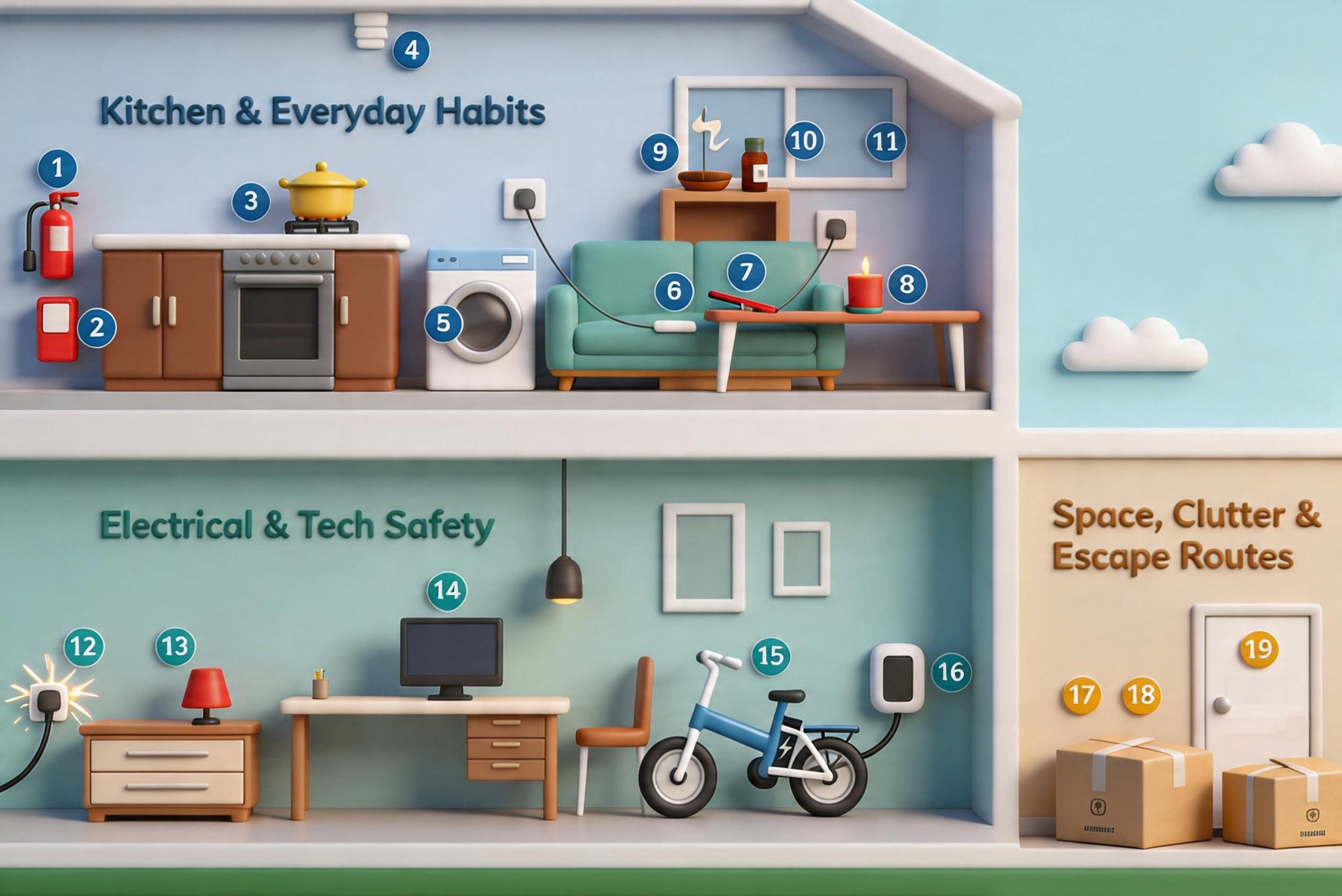
Kitchen & Everyday Habits
1. Do you have a working fire extinguisher? (Yes: +1 point)
2. Do you have a fire blanket? (Yes: +1 point)
3. Do you monitor pots and pans closely while cooking? (Yes: +1 point)
4. Are your smoke detectors installed and tested regularly? (Yes: +1 point)
5. Do you leave clothes in the dryer unattended, risking lint buildup? (No: +1 point)
6. Do you charge devices on beds or sofas where heat can build up on flammable surfaces? (No: +1 point)
7. Do you leave hair curlers, straighteners, or irons switched on or unattended? (No: +1 point)
8. Do you use candles or any open flame at home with proper supervision and distance from flammable items? (Yes: +1 point)
9. If you have an altar or incense setup, is it placed in a well-ventilated and stable area? (Yes: +1 point)
10. Are you using appropriate, non-excessively flammable oils or incense materials? (Yes: +1 point)
11. Do you take precautions against nearby burning offerings (e.g., closing windows, clearing surroundings)? (Yes: +1 point)
| Why it matters: Small daily habits and open-flame activities can quickly escalate into kitchen or home fires if left unattended. |
Electrical & Tech Safety
12. Do you overload sockets or use damaged cords? (No: +1 point)
13. If you’ve bought appliances from overseas platforms such as Taobao, have you checked quality, wiring, and voltage compatibility? (Yes: +1 point)
14. Do your electrical appliances carry the Fire Safety Mark? (Yes: +1 point)
15. If you own a PMD or e-bike, do you avoid charging it overnight or unattended? (Yes: +1 point)
16. Do you use only compliant batteries and chargers? (Yes: +1 point)
| Why it matters: Electrical faults and battery-related issues are among the most common fire causes in Singapore homes and can escalate rapidly. |
Space, Clutter & Escape Routes
17. Are your corridors, walkaways, and exits free from clutter or flammable items (e.g., paper, clothes, storage boxes)? (Yes: +1 point)
18. Do you ensure flammable materials are not stored near heat sources or electrical panels? (Yes: +1 point)
19. Do you keep escape routes clear in case of emergency? (Yes: +1 point)
| Why it matters: In a fire, clutter can slow evacuation and increase risk. Clear pathways can make a critical difference in escaping safely. |
So… How Did You Score?
- 15 points and above: You’ve got most key fire safety measures in place – continue being vigilant!
- 7 to 14 points: There may be a few areas worth reviewing – refer to the SCDF fire safety guidelines for tips.
- 6 points and below: Consider taking steps to strengthen your fire safety habits – fire prevention and preparedness are crucial to a safe home!
This checklist is intended as a simple self-assessment to help you identify potential gaps in your home fire safety practices. It is not meant to replace professional advice. When in doubt, always refer to SCDF’s official fire safety guidelines.
Is Basic Fire Insurance Sufficient?
Even with the best precautions, not all risks are within your control. Fires can start in neighbouring units, from external sources, or due to unexpected electrical faults. As a result, situations can escalate quickly, even if your own home practices are safe.
This is where understanding your coverage becomes important. Basic fire insurance typically covers structural damage such as walls, ceilings, and fixtures. However, it does not cover renovations and built-in fixtures, furniture and personal belongings, or temporary accommodation if your home becomes uninhabitable.
Therefore, relying on basic fire insurance alone may leave important gaps. A comprehensive home insurance plan can complement your coverage by protecting your home contents, renovation costs, and other scenarios beyond fire – ensuring you can restore in ease, if the time calls.

Don’t Just Prevent, Be Prepared
Fire safety at home starts with small, consistent habits. For example, turn off appliances when not in use, check sockets regularly, and keep flammable items away from heat sources.
Although these actions may seem minor, they can significantly reduce the risk of a fire.
At the same time, prevention alone may not be enough. Hence, having the right home insurance coverage is equally important. It ensures that if an unexpected fire occurs, you are not left to manage the financial impact on your own.
Take a moment to review your home coverage today. A quick check now can help you stay protected and avoid costly setbacks in the future.

[End]
Information is accurate as at 28 April 2026. This policy is underwritten by Etiqa Insurance Pte. Ltd. (Company Reg. No. 201331905K). Protected up to specified limits by SDIC.
Tiq by Etiqa Insurance Pte. Ltd.
A digital insurance channel that embraces changes to provide simple and convenient protection, Tiq’s mission is to make insurance transparent and accessible, inspiring you today to be prepared for life’s surprises and inevitabilities, while empowering you to “Live Unlimited” and take control of your tomorrow.
With a shared vision to change the paradigm of insurance and reshape customer experience, Etiqa created the strong foundation for Tiq. Because life never stops changing, Etiqa never stops progressing. A licensed life and general insurance company registered in the Republic of Singapore and regulated by the Monetary Authority of Singapore, Etiqa is governed by the Insurance Act and has been providing insurance solutions since 1961. It is 69% owned by Maybank, Southeast Asia’s fourth largest banking group, with more than 22 million customers in 20 countries; and 31% owned by Ageas, an international insurance group with 33 million customers across 16 countries.
Discover the full range of Tiq online insurance plans here.